Hover to look through the loupe ·
← Science Who is on the stampJames Franck 1882–1964James Franck was born in 1882 in Hamburg into a Jewish family and earned his doctorate in Berlin in 1906. With Gustav Hertz he carried out the famous Franck–Hertz experiment, which showed that atoms absorb energy only in fixed portions and strongly supported Niels Bohr's model of the atom; the two shared the 1925 Nobel Prize in Physics. During the First World War Franck…Life story and all stamps · 1 stamps →Who is on the stampMax Born 1882–1970Max Born was born in 1882 in Breslau, then in Germany, into a Jewish family; as a young man he was baptised a Lutheran, partly to fit into German society. At the University of Göttingen he studied under the great mathematicians Felix Klein, David Hilbert and Hermann Minkowski, and he later made the city one of the world capitals of theoretical physics, guiding a remarkable…Life story and all stamps · 1 stamps →
Stamp · West Germany (FRG) · 1982
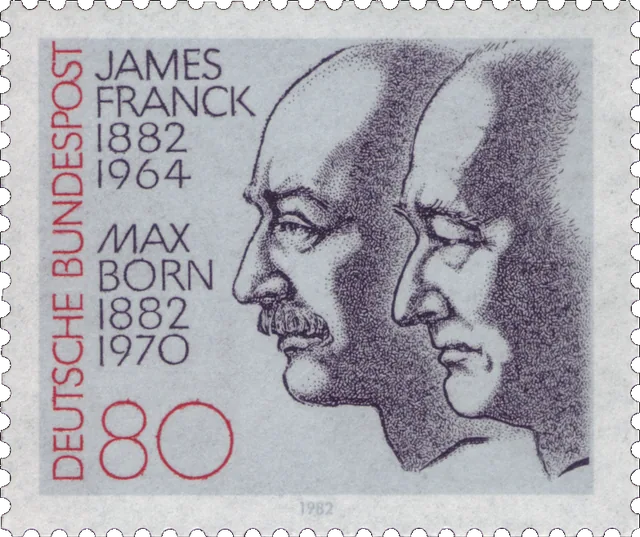
James Franck, Max Born
Nobel physicist whose experiment confirmed the quantum model of the atom
About this stamp
Two overlapping left-facing profile portraits of the physicists James Franck (in front, with a moustache) and Max Born (behind), drawn in fine purple-grey stippling on a pale blue-grey background. Inscribed vertically 'DEUTSCHE BUNDESPOST', with 'JAMES FRANCK 1882 1964', 'MAX BORN 1882 1970' and the red denomination 80. Issued by West Germany in 1982 (the year is printed below), the centenary of both scientists' births.
- Country
- West Germany (FRG)
- Issued
- 1982
- Hall
- Science
- Licence
- Public domain
- Source
- Wikimedia Commons ↗ · Deutsche Bundespost